
Connect an app to a managed Postgres database
By the end of this tutorial you will have a Postgres database running next to your app, a connection string injected into the app as an environment variable, and a check that the app actually sees it. No password handling, no copy and paste of credentials.
Before you start
- A running Levelrail instance and the CLI logged in to it (installing).
- An app to connect. This tutorial reuses the
helloapp from Deploy a Docker app. Any app works.
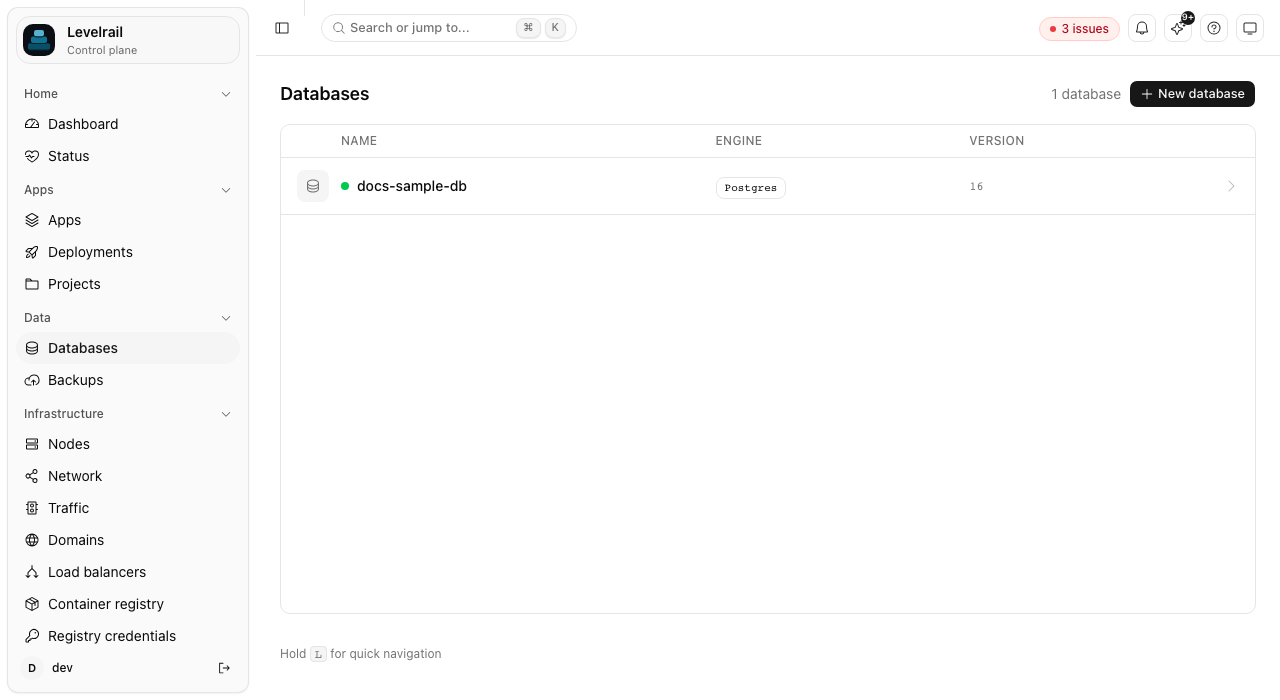
1. Create the database
levelrail-cli databases create --name main-db --engine postgres --version 16database "main-db" created
name: main-db
engine: postgres
version: 16
tls: noPostgres is one of eight engines on the same registry (Redis, MySQL, MongoDB, MariaDB, KeyDB, Dragonfly, and ClickHouse are the others), so the rest of this tutorial works with a different --engine too. Check that it came up:
levelrail-cli databases status main-dbTYPE STATUS REASON MESSAGE LAST TRANSITION
Ready True AlreadyRunning 2026-10-05T02:21:40ZThe first start pulls the image, so allow a minute on a fresh server.
2. Connect the app
levelrail-cli apps connect hello main-dbenv_var: MAIN_DB_DATABASE_URL
database_name: main-db
field: url
host: db-main-db (mesh_dns=false cross_node=false)Levelrail created a variable named MAIN_DB_DATABASE_URL holding the full connection string. List an app's connections any time:
levelrail-cli apps connections list helloENV_VAR DATABASE FIELD HOST MESH_DNS CROSS_NODE
MAIN_DB_DATABASE_URL main-db url db-main-db false falseYou can pick a different field or variable name. For example, levelrail-cli apps connect hello main-db --field host --env-var DB_HOST injects only the host. The fields are url, host, port, username, password, and database.
3. Restart so the app picks it up
The value is injected when a container is created, so restart the app:
levelrail-cli apps restart hello
levelrail-cli apps status hello
Wait until Ready shows True, then read the variable from inside the running container:
levelrail-cli apps exec hello -- printenv MAIN_DB_DATABASE_URLpostgres://main-db:<password>@db-main-db:5432/main-db?sslmode=requireThe app reaches the database by its container name on a private network, with TLS required. Levelrail generated the credentials, so you never choose or paste a password.
If apps exec answers app has no running container, the new container is still starting. Wait a few seconds and run it again.
What the reachability badge means
apps connections list and the dashboard's Connections card show whether the app and database are on the same node, on different nodes with the WireGuard mesh configured, or on different nodes with the mesh off. The last case does not connect. See Connecting apps to databases for the full table.
Clean up
levelrail-cli apps disconnect hello MAIN_DB_DATABASE_URL
levelrail-cli databases delete main-db
Keep the database if you plan to follow the next tutorial.
Where to go next
- Back up Postgres to S3 and test the restore: protect the data you just connected.
- Managing databases: resources, public access for a GUI client, and slow query tracking.
- Network topology: see every app-to-database connection drawn across your servers.