Your own cloud. No Kubernetes.
Put your apps on your own servers. Push code and get HTTPS, logs and one-click rollback, with no Kubernetes to learn.
curl -fsSL https://levelrail.com/install.sh | sudo sh For side projects, homelabs, agencies and internal tools: see the use cases. Coming from Heroku or Coolify? Migrate.
- 442 one-click apps. 200 MB idle memory, measured. 1.5% CPU while idle, measured
- 0 Kubernetes to learn. v0.9.2 latest release. Apache 2.0 one edition, nothing gated
- 0 SSH keys in CI. 1 Go binary, no Kubernetes. 1 click to roll back
Instead of
- CI runner , replaced by Levelrail
- Reverse proxy , replaced by Levelrail
- Cert scripts , replaced by Levelrail
- Log tailing , replaced by Levelrail
- Metrics stack , replaced by Levelrail
- Backup cron , replaced by Levelrail
- One binary
Pieces you would otherwise set up by hand.
Install in one click442 apps
Use cases
Run the apps you already use, or your own code.
Pick the closest match and see how it works on Levelrail.
Star the repo if you want to follow the project, or to help other people who self-host find it. Star on GitHub
- Next.js and Node appsGit-driven deploys for containerized web apps on your own server.
- Side projects on one VPSA handful of projects on one server, without per-service platform fees.
- Homelab and mixed serversA home server, a VPS and a cloud VM, managed from one place.
- Databases with backupsManaged databases with scheduled, verified backups on your own storage.
- Internal toolsDashboards, automation and wikis, with roles and an audit trail.
- Agencies and many clientsScoped access, an audit trail and per-client nodes for client work.
Exploring Levelrail Cloud We are exploring a managed version for people who would rather not run servers. Self-hosting stays free and complete, with the same code and no gated features.
Tell us if you would use itBare server to live app in ten minutes
About ten minutes: install, connect, deploy. Use a sample, a template or your own repository, with HTTPS and logs from the first deploy.
Install. One command on a Linux box. It checks the host, installs Docker if needed and verifies the release checksum.
Connect a server. Open the one-time setup link to create the admin. Add more servers later: each server calls home over an encrypted link, so you open no extra ports.
What you would otherwise run
Most small teams end up with one of three setups. Each works, until it does not.
-
A pile of scripts
Fine until the person who wrote them is away. Levelrail adds deploys that go live only after a health check, HTTPS, logs and one-command rollback.
-
A managed platform
Convenient, but your apps, data and bill live on someone else's servers. Levelrail runs on machines you own.
-
Kubernetes
Built for fleets. Levelrail is for 3 to 50 services on 1 to 10 machines, with no cluster to operate.
Push code. Get a secure app running.
HTTPS and logs from the first deploy, and a rollback when an update goes wrong.
Learn more about deploys- Deploy on git pushA sample, a template or your own repository.
- HTTPS from the first deployThe padlock is set up for you.
- One-command rollbackGo back when an update goes wrong.
Instead of
- CI runner , replaced by Levelrail
- Reverse proxy , replaced by Levelrail
- Cert scripts , replaced by Levelrail
- Log tailing , replaced by Levelrail
- Metrics stack , replaced by Levelrail
- Backup cron , replaced by Levelrail
- One binary
Pieces you would otherwise set up by hand.
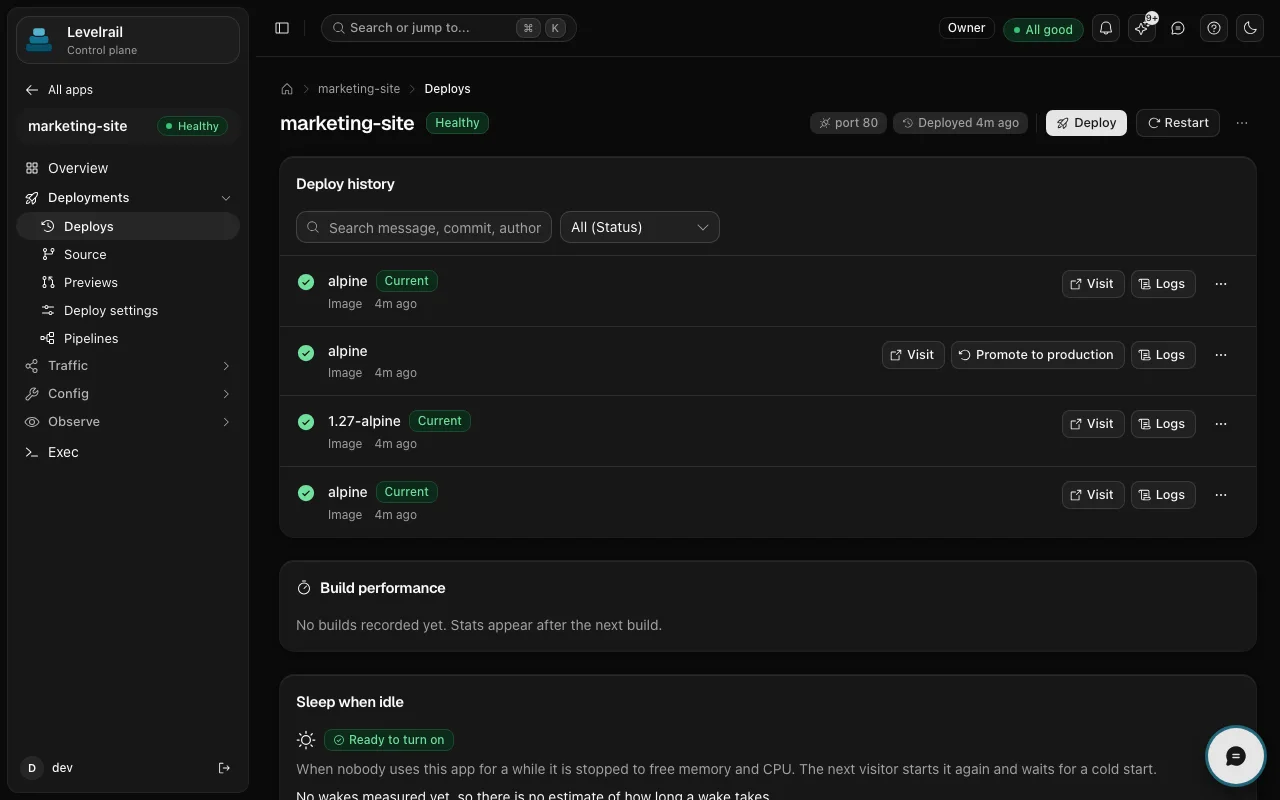
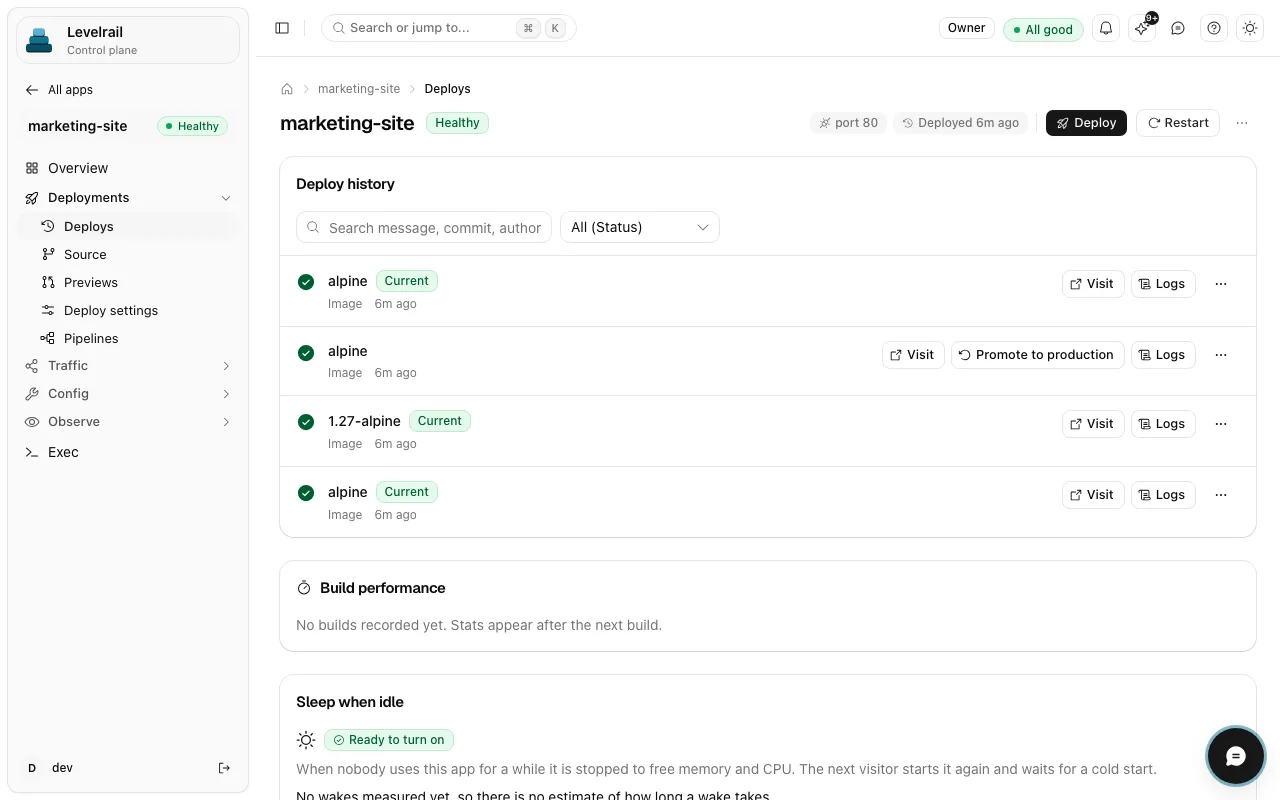
See a deploy and its logs, live
Break the deploy and watch the old version keep serving. Filter the logs the way you would on a real node.
marketing-site / deploy
alpineRolling out
Rolling out
Traffic stays on the current deploy until the new one is healthy.
- BuildSkipped
Using a pre-built image, no build step ran.
- Health checkWaiting0/5
- CutoverWaiting
- CleanupWaiting
marketing-site / observe
LogsLive
Nothing matches yet. New lines show up here as they arrive.
Sample traffic. Real logs stay on the node that wrote them.
Light enough to forget it is there
Measured on 2026-10-19 on a 2 vCPU, 8 GB Linux test box, with no apps under load. One run on one box, not a benchmark of your hardware. What is verified and the method.
- 200 MBmemory used when idle, Levelrail server
- 253 MBpeak memory in the same run
- 1.5%CPU while idle
- 1 binaryGo, no Kubernetes
Agents, not SSH
A small agent runs on each server and talks to Docker directly. Nothing shells out to the docker CLI.
The architectureIt dials out. Each server calls home over an encrypted link. No inbound ports, no SSH keys on your servers.

Data stays put. Metrics and logs stay on the node. Queries fan out to the agents.
Open source
Apache 2.0. One edition. Nothing behind a plan.
No license key. Everything below ships in the same binary, free.
Levelrail is built in the open. A star helps other people find it.
Star on GitHubQuestions people ask first
Is it Levelrail or Level Rail?
Levelrail, one word. People often search for it as "Level Rail" or "LevelRail", and all of those mean the same open source, self-hosted deployment platform at levelrail.com, not a railway product.
What is Levelrail?
A self-hosted platform that turns one or more Linux servers into a private cloud. Point it at a git repository or a Docker image and it builds, deploys, and keeps the app running, with TLS, logs, metrics, and rollback. The control plane and the node agent are each a single Go binary, and Docker is the only container runtime.
How is this different from Coolify or Railway?
Most self-hosted platforms in this category, Coolify included, manage remote servers by SSHing in and running docker CLI commands, then parsing the text output. Levelrail's agent dials out over mTLS and talks to the Docker Engine API directly, nothing shells out to the docker CLI, and a level-triggered reconciler replaces polling loops. Railway is a managed cloud you don't control, while Levelrail runs on servers you own. The comparison page covers where the other projects are the better choice.
Do I need to know Kubernetes?
No. Levelrail is not a Kubernetes alternative: there is no bin-packing scheduler and no CRDs, autoscaling is in beta, and nothing to learn beyond apps, domains, and databases. It is built for running 3 to 50 services on 1 to 10 machines without operating a cluster.
Is it free?
Yes. Levelrail is Apache 2.0 licensed with one edition: no license key and no feature gated behind a plan. OAuth sign-in, two-factor authentication, audit logging, resource-scoped IAM, and scheduled backups all ship in the same binary for everyone. OpenID Connect sign-in is included, and SAML and SCIM are available as a beta behind a toggle that is off by default.
Is it ready for production?
A single node is the well-tested path. APIs, the app spec format, and the on-disk layout can change between releases on the way to 1.0. A single node is the well-tested path, and the feature status page labels every area as stable, beta, or behind a flag, with the evidence for each.
Can I run it on a single server?
Yes, and that is the default. On one server the control plane runs the node agent in the same process and talks to it through an in-process transport, so there is nothing extra to install. The same code path serves one node or ten.
What happens if a deploy fails?
With the default blue-green strategy, and with rolling, traffic only moves to the new container once its readiness probe passes, not once the process merely starts. If the probe never passes, the old container keeps serving and the deploy fails with a specific reason such as OOMKilledDuringReadiness. The recreate strategy stops the old container before starting the new one, so expect a short gap. Prior images stay pinned, so garbage collection cannot remove a rollback target.
Does it support multiple servers?
Yes, and it is in beta. A second server joins with a one-time token and gets its own client certificate. Every agent dials out to the control plane, so managed servers need no inbound ports. You can cordon and drain nodes and pin apps to them. The WireGuard mesh and cross-host service DNS are the least verified part of this area.
Is there an AI or MCP integration?
Yes, in beta. An MCP server exposes over 240 tools, enabled in toolsets on demand, over the same HTTP API and permission model the dashboard uses, so an AI client can list apps, read logs, get metrics, diagnose a failed deploy, trigger a deploy, or roll back. A token limited to fewer abilities gets the same 403 the REST API returns. AI is never part of the reconciliation path.
Still stuck? Ask the community or read the docs.
Run it on a server today.
One command on a Linux box, then a setup wizard. About ten minutes to your first deployed app.
curl -fsSL https://levelrail.com/install.sh | sudo sh Levelrail is Apache 2.0 licensed, with one edition and nothing behind a plan. What is open, and what is not here yet.